
Knowledge Base Entry
IG-100 Gas Suppression System – Working Principle, Components & Applications
Nov 2026
1. Introduction
An IG-100 Gas Suppression System is a clean-agent fire extinguishing system that uses nitrogen gas (N₂) to control and extinguish fires in enclosed, high-value and mission-critical environments.
IG-100 consists of nitrogen and is colourless, odourless, electrically non-conductive and leaves no residue after discharge. It extinguishes fire primarily by reducing the oxygen concentration within the protected enclosure to a level that prevents combustion.
It is particularly suitable for protecting data centres, server rooms, UPS rooms, control rooms and other facilities containing sensitive electronic equipment.
2. Direct Answer
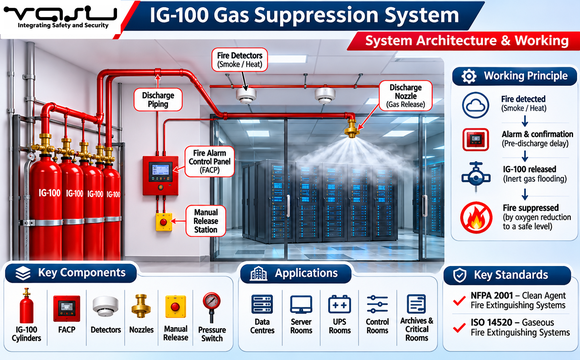
IG-100 is an inert gas fire suppression system that uses nitrogen to extinguish fires by reducing oxygen concentration inside a protected enclosure. The system operates through automatic fire detection, alarm activation, controlled gas release and distribution through a network of pipes and discharge nozzles.
3. Working Principle
The IG-100 system operates through a coordinated fire detection and gas discharge sequence.
Step 1 – Fire Detection
Smoke or heat detectors identify signs of fire within the protected area and transmit signals to the Fire Alarm Control Panel (FACP).
Step 2 – Alarm & Confirmation
The control panel processes the detector signals and initiates the configured alarm and release sequence, including the pre-discharge warning and time delay where applicable.
Step 3 – IG-100 Gas Release
Following the release command, the cylinder valve assembly operates and releases nitrogen through the distribution piping network.
Step 4 – Gas Distribution
Discharge nozzles distribute the nitrogen throughout the protected enclosure to achieve the required design concentration.
Step 5 – Fire Suppression
The nitrogen reduces oxygen concentration within the enclosure, interrupting the combustion process and suppressing the fire.
4. Main Components
1. IG-100 Gas Cylinders
High-pressure storage cylinders containing nitrogen gas.
2. Cylinder Valve Assembly
Controls the release of stored nitrogen from the cylinders.
3. Discharge Piping Network
A specially designed pipe network that transports nitrogen from the cylinder bank to the protected enclosure.
4. Discharge Nozzles
Distribute the extinguishing agent throughout the protected space.
5. Fire Detection System
Smoke and heat detectors identify fire conditions and provide signals to the control panel.
6. Fire Alarm Control Panel (FACP)
Processes detection signals and controls the configured suppression release sequence.
7. Manual Release Station
Allows authorised personnel to initiate the suppression release sequence manually, subject to system configuration.
8. Pressure Switch / Discharge Monitoring
Provides confirmation or monitoring of system discharge, depending on the equipment arrangement.
9. Alarm and Warning Devices
Audible and visual alarms alert occupants before and during system operation.
10. Pressure Relief Vent
Manages enclosure pressure changes during gas discharge and helps protect the building structure.
5. Types / System Configurations
IG-100 suppression installations can be configured according to the protected area’s requirements.
- Single Cylinder System: Uses an individual cylinder arrangement for a protected enclosure.
- Multiple Cylinder System: Uses a bank of cylinders to provide the required agent quantity.
- Centralised Cylinder Bank: A central storage arrangement can serve multiple protected zones through an appropriately designed system.
- Modular System: Uses separate system arrangements for individual protected spaces.
The final configuration depends on the hazard assessment, enclosure volume, design concentration, equipment limitations and applicable standards.
6. Applications
IG-100 systems are commonly considered for:
- Data Centres and Server Rooms
- UPS and Battery Support Rooms
- Electrical and Control Rooms
- Telecom and Communication Facilities
- Power Generation Facilities
- Industrial Control Centres
- Archives and Document Storage Areas
- Critical Infrastructure Facilities
7. Technical Specifications & Design Considerations
The following parameters should be evaluated during system design:
| Parameter | Design Consideration |
|---|---|
| Extinguishing Agent | Nitrogen (IG-100) |
| Agent Properties | Colourless, odourless and electrically non-conductive |
| Storage Pressure | Manufacturer-approved system configuration |
| Design Concentration | Based on hazard classification and applicable standard |
| Protected Volume | Room dimensions and enclosure volume |
| Discharge Nozzles | Hydraulic flow calculation and nozzle distribution |
| Piping Network | Pipe sizing and pressure-loss calculations |
| Enclosure Integrity | Ability to retain the required concentration |
| Pressure Relief | Enclosure pressure management |
| Hold Time | Required concentration retention period |
ISO 14520-13:2015 covers IG-100 system requirements and includes nominal storage pressures of 200 bar and 300 bar at 15°C. Other configurations require applicable validated design data.
8. Installation Considerations
- Conduct a detailed hazard assessment before system design.
- Verify the protected enclosure volume and room integrity.
- Evaluate raised floors and false ceiling voids where applicable.
- Position detection devices according to the approved design.
- Install cylinders in an accessible and appropriately protected location.
- Ensure piping and nozzle arrangements comply with approved hydraulic calculations.
- Provide suitable pre-discharge alarms and warning signage.
- Evaluate pressure relief requirements.
- Provide safe evacuation arrangements and appropriate personnel safety measures.
- Carry out functional testing and commissioning before handover.
9. Advantages & Limitations
Advantages
- Uses nitrogen as the extinguishing agent.
- Electrically non-conductive.
- Leaves no extinguishing residue.
- Suitable for sensitive electronic equipment.
- Does not require post-discharge chemical clean-up of equipment.
- Can be designed for critical enclosed environments.
Limitations
- Requires a properly sealed protected enclosure.
- High-pressure cylinder storage requires suitable space and handling arrangements.
- Discharge can create significant enclosure pressure changes.
- Oxygen reduction can create an unsafe atmosphere for occupants.
- Requires specialist hydraulic calculations and approved equipment.
- Room integrity and personnel safety must be addressed during design.
10. Standards & References
The following standards are relevant to IG-100 gaseous fire suppression system design and implementation:
- NFPA 2001: Standard on Clean Agent Fire Extinguishing Systems.
- ISO 14520-1:2023: Gaseous Fire-Extinguishing Systems – General Requirements.
- ISO 14520-13:2015: Gaseous Fire-Extinguishing Systems – IG-100 Extinguishant.
- Manufacturer Design Manuals: Equipment-specific installation, operation and maintenance requirements.
The applicable editions, local regulations and approval requirements should be verified for each project.
11. Testing, Inspection & Maintenance
Regular inspection and maintenance help ensure system readiness and reliability.
Key activities include:
- Inspection of cylinder pressure and condition.
- Verification of cylinder valves and operating mechanisms.
- Inspection of piping, fittings and discharge nozzles.
- Testing of smoke and heat detectors.
- Functional testing of the Fire Alarm Control Panel.
- Verification of manual release and alarm interfaces.
- Inspection of pressure relief arrangements.
- Verification of room integrity.
- Review of system records and maintenance documentation.
Inspection and testing frequency should follow applicable standards and manufacturer recommendations.
12. Frequently Asked Questions (FAQs)
Q1. What is IG-100 gas?
IG-100 is an inert gas extinguishing agent consisting of nitrogen (N₂), used in gaseous fire suppression systems.
Q2. How does an IG-100 system extinguish fire?
It reduces oxygen concentration inside the protected enclosure to a level that prevents sustained combustion.
Q3. Is IG-100 suitable for data centres?
Yes. It is commonly considered for data centres and server rooms because it is electrically non-conductive and leaves no extinguishing residue.
Q4. Does IG-100 leave any residue after discharge?
No. Nitrogen is a gaseous extinguishing agent and does not leave chemical extinguishing residue.
Q5. Is IG-100 safe for occupied areas?
Nitrogen is not toxic at normal atmospheric conditions, but the system reduces oxygen concentration during discharge. This can create an oxygen-deficient atmosphere. Occupant safety, evacuation, warning systems and exposure limits must therefore be addressed in the design.
Q6. Which standards apply to IG-100 systems?
NFPA 2001, ISO 14520-1 and the specific IG-100 requirements in ISO 14520-13 are relevant references.
13. Conclusion
The IG-100 Gas Suppression System provides an inert-gas-based fire protection solution for critical facilities where equipment protection, operational continuity and fire safety are essential.
Proper hazard assessment, system engineering, hydraulic calculations, enclosure integrity, pressure management and periodic maintenance are important to ensure effective and reliable operation.