
Knowledge Base Entry
IP Rating (Ingress Protection) – Meaning, IP Codes & Applications
Nov 2026
1. Introduction
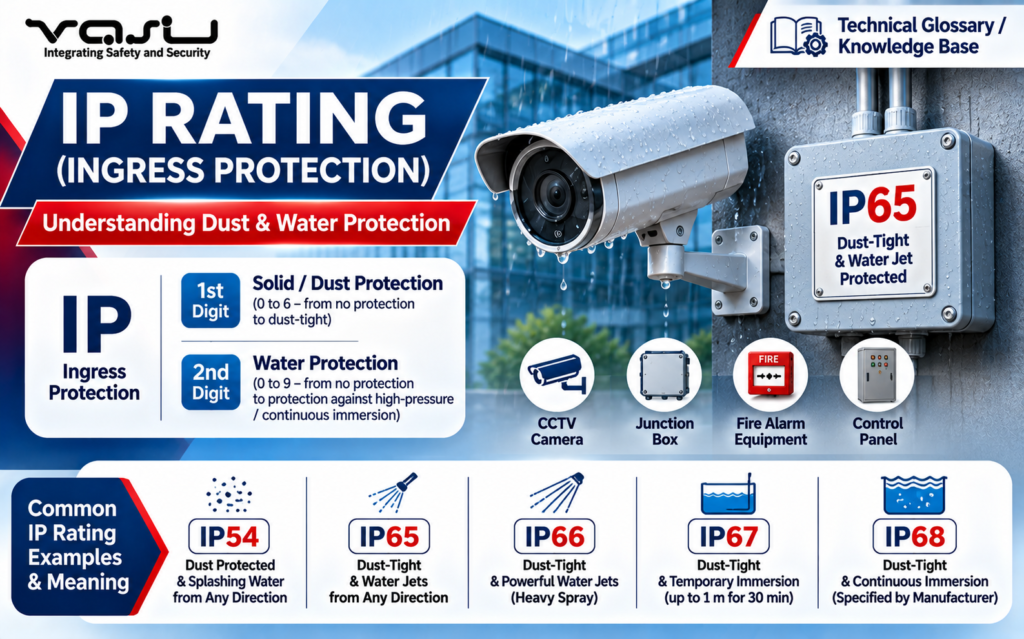
IP Rating, also known as Ingress Protection Rating, classifies the degree of protection provided by an electrical equipment enclosure against the entry of solid foreign objects and water.
The IP Code is defined under IEC 60529 – Degrees of Protection Provided by Enclosures (IP Code). It is commonly used when selecting CCTV cameras, junction boxes, electrical panels, detectors and other equipment installed in indoor, outdoor and industrial environments.
2. Understanding the IP Code
An IP rating generally consists of two characteristic digits.
Example: IP65
- IP – Ingress Protection.
- First Digit (6) – Protection against solid objects and dust.
- Second Digit (5) – Protection against water jets.
The higher the digit, the greater the specified level of protection within that particular category.
3. First Digit – Protection Against Solid Objects
| Digit | Protection Level |
|---|---|
| 0 | No protection |
| 1 | Objects of 50 mm diameter and above |
| 2 | Objects of 12.5 mm diameter and above |
| 3 | Objects of 2.5 mm diameter and above |
| 4 | Objects of 1.0 mm diameter and above |
| 5 | Dust-protected; limited ingress permitted without harmful effects |
| 6 | Dust-tight |
4. Second Digit – Protection Against Water
| Digit | Protection Level |
|---|---|
| 0 | No protection |
| 1 | Vertically falling water drops |
| 2 | Vertically falling water drops when enclosure is tilted up to 15° |
| 3 | Water spraying up to 60° from the vertical |
| 4 | Water splashing from any direction |
| 5 | Water jets from any direction |
| 6 | Powerful water jets from any direction |
| 7 | Temporary immersion under specified test conditions |
| 8 | Continuous immersion under conditions specified by the manufacturer and standard |
| 9 | High-pressure and high-temperature water jets |
5. Common IP Ratings & Their Meaning
| IP Rating | Meaning |
|---|---|
| IP54 | Dust-protected and protected against water splashing |
| IP55 | Dust-protected and protected against water jets |
| IP65 | Dust-tight and protected against water jets |
| IP66 | Dust-tight and protected against powerful water jets |
| IP67 | Dust-tight and protected against temporary immersion |
| IP68 | Dust-tight and protected against continuous immersion under specified conditions |
Important: IPX7 or IPX8 immersion protection does not automatically establish protection against IPX5 or IPX6 water jets. Check the equipment’s declared rating and test conditions.
6. Applications in Fire & Electronic Security Systems
| Equipment | IP Rating Consideration |
|---|---|
| Indoor CCTV Camera | Select according to indoor environmental conditions |
| Outdoor CCTV Camera | Consider dust and rain exposure |
| Junction Boxes | Select according to installation environment |
| Outdoor Access Control Reader | Consider rain and dust exposure |
| Fire Alarm Equipment | Follow equipment location and manufacturer requirements |
| Industrial Control Panels | Consider dust, water and site conditions |
| Outdoor Security Enclosures | Verify the declared enclosure rating and installation conditions |
The required IP rating must be determined by the actual installation environment and project specifications. No single IP rating is suitable for every application.
7. Important Engineering Considerations
- Review the environmental conditions at the installation location.
- Check the manufacturer’s declared IP rating and supporting documentation.
- Verify cable glands, connectors and enclosure covers.
- Ensure installation openings do not compromise the declared protection.
- Consider temperature, humidity, corrosion and UV exposure separately.
- Check the IK rating separately where mechanical impact protection is required.
- For hazardous areas, verify the applicable Ex certification; an IP rating alone does not establish explosion protection.
8. IP Rating vs IK Rating
IP and IK ratings measure different types of enclosure protection.
| Parameter | IP Rating | IK Rating |
|---|---|---|
| Standard | IEC 60529 | IEC 62262 |
| Measures | Protection against solid-object and water ingress | Protection against external mechanical impacts |
| Example | IP66 | IK10 |
| Application | Outdoor CCTV and electrical enclosures | Equipment exposed to potential physical impact |
Both ratings may be relevant when selecting equipment for demanding industrial and outdoor environments.
9. Frequently Asked Questions (FAQs)
Q1. What does IP stand for?
IP stands for Ingress Protection. It classifies enclosure protection against the entry of solid foreign objects and water.
Q2. What does IP65 mean?
IP65 indicates a dust-tight enclosure with protection against water jets under specified test conditions.
Q3. Is IP67 waterproof?
IP67 indicates protection against temporary immersion under specified test conditions. It does not mean the equipment is suitable for every underwater application.
Q4. What is the difference between IP65 and IP66?
Both ratings are dust-tight. IP65 is tested against water jets, while IP66 is tested against more powerful water jets.
Q5. Is IP68 better than IP67?
IP68 covers continuous immersion under specified conditions, whereas IP67 covers temporary immersion. The actual immersion depth and duration for IP68 must be checked in the manufacturer’s specifications.
Q6. Does IP66 provide impact protection?
No. Mechanical impact protection is classified separately under the IK rating system.
Q7. Which IP rating is suitable for outdoor CCTV cameras?
The required rating depends on exposure to dust, rain, water jets and other environmental conditions. Check the project specification and camera manufacturer’s declared rating.
10. Conclusion
IP ratings are an important consideration in selecting electrical and electronic equipment for Fire & Life Safety and Electronic Security applications. Understanding the two IP code digits helps engineers and project teams evaluate enclosure protection against dust and water ingress.
Correct equipment selection, installation practices and verification of manufacturer documentation help ensure that the specified level of protection is maintained throughout the system lifecycle.