
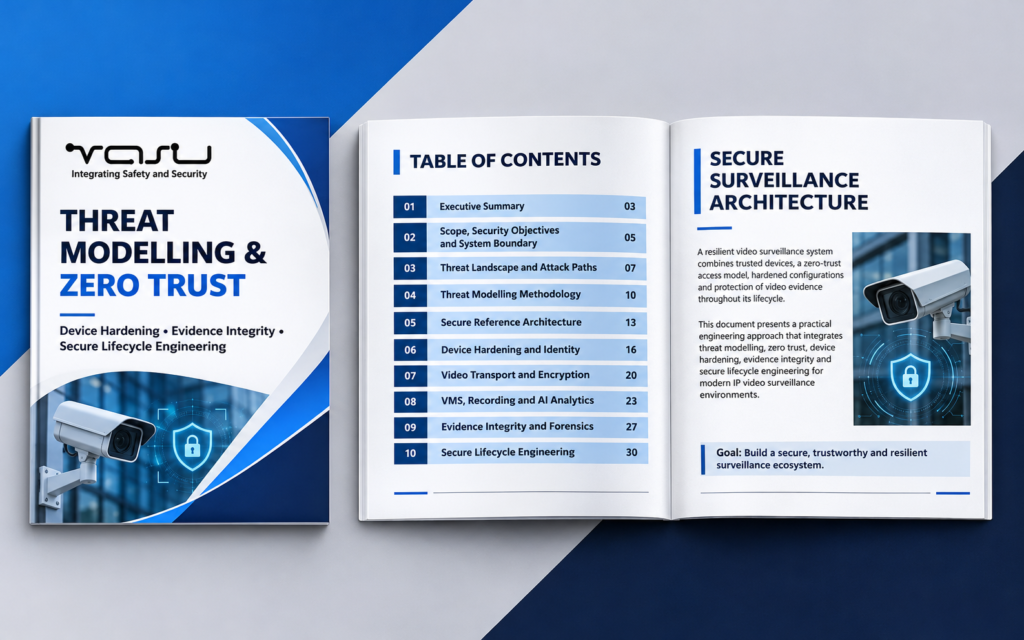
Whitepaper
Threat Modelling, Zero Trust, Device Hardening, Evidence Integrity and Secure Lifecycle Engineering
Nov 2026
Executive Summary
An IP video surveillance system is simultaneously a security instrument, a network of embedded computers, a software platform and a repository of sensitive information. A system can be visually functional yet cyber-insecure: video streams may remain available while credentials are compromised, clocks are manipulated, recordings are deleted or management interfaces are exposed. The relevant engineering objective is therefore cyber-resilience across acquisition, transport, processing, storage, access and incident response.
This white paper establishes a defence-in-depth approach applicable to IP cameras, network video recorders (NVRs), video management systems (VMS), analytics servers, storage, operator workstations and remote-access infrastructure. It aligns with NIST CSF 2.0, NISTIR 8259-series guidance, NIST SP 800-207, ONVIF cybersecurity recommendations and established secure-by-design principles [1-6].
Core finding: Security cannot be achieved by a single device feature or VLAN. It depends on verifiable identity, constrained communications, controlled administrative access, tested updates, evidence protection, continuous monitoring and recoverable operations.
1. Scope, Security Objectives and System Boundary
The security boundary extends beyond cameras and recording servers. It encompasses power-over-Ethernet switches, optical links, DNS/NTP, directory services, certificates, mobile clients, integrations, update channels, vendor support paths and off-site retention. These dependencies should appear in design documents and asset inventories, even when delivered by different contractors.
| Security property | CCTV-specific requirement |
|---|---|
| Confidentiality | Prevent unauthorised viewing, copying or disclosure of live and recorded footage. |
| Integrity | Preserve camera configuration, timestamps, video records, event metadata and audit trails against unauthorised alteration. |
| Availability | Maintain essential observation, recording, alarming and recovery functions within defined outage tolerances. |
| Authenticity | Verify users, devices, servers and software updates through approved mechanisms. |
| Accountability | Attribute administrative changes, exports and investigations to authorised identities. |
2. Threat Landscape and Attack Paths
Surveillance environments combine embedded firmware with frequently long service lives. Common attack paths include inherited default or shared credentials, vulnerable internet-facing management services, outdated firmware, permissive firewall rules, insecure integrations and unmanaged remote-support tools. Network compromise elsewhere in the enterprise can also lead to lateral movement towards the surveillance estate.
2.1 Representative threat scenarios
| Scenario | Operational impact | Primary defensive approach |
|---|---|---|
| Exposed camera interface | Unauthorised viewing or control | No direct public exposure; access via approved gateway/VPN with MFA |
| Compromised VMS account | Mass footage access or export | Least privilege, MFA where supported, audited exports |
| NVR ransomware | Loss of recording or forensic access | Segmentation, immutable/offline backups, recovery tests |
| Malicious firmware/update | Persistent device compromise | Signed updates and supplier assurance |
| Time-source interference | Disputed event sequence | Controlled NTP and monitored clock drift |
| Third-party integration abuse | Privilege escalation or data leakage | Scoped API identities and interface testing |
Published advisories illustrate that internet-connected cameras can become exploitation targets. A March 2026 national cybersecurity advisory highlighted active exploitation concerns involving exposed cameras; the generalizable response is to eliminate unnecessary exposure and maintain risk-based patching [7].
3. Threat Modelling Methodology
A threat model should begin with the actual data flows: camera to recorder, camera to analytics, recorder to client, VMS to identity service, operator export to evidence repository, and remote maintenance into the protected estate. For each flow, identify the communicating identities, allowed protocols, security controls, trust boundary and expected failure behaviour.
STRIDE can be used as a structured analytical lens: spoofing, tampering, repudiation, information disclosure, denial of service and elevation of privilege. It is not an accreditation framework; it is a practical method for exposing design gaps before commissioning.
3.1 Risk scoring example
An illustrative five-by-five matrix scores likelihood (L) and impact (I) from 1 to 5 and computes a screening score R = L x I. For example, an internet-exposed camera management interface may receive L=4 and I=4, giving R=16. These values are design assumptions, not a claim of measured incident probability. Organisations should define their own risk appetite and decision thresholds.
| Illustrative risk | L | I | R | Suggested response |
|---|---|---|---|---|
| Public camera admin portal | 4 | 4 | 16 | Remove internet exposure |
| Shared operator accounts | 4 | 3 | 12 | Individual identities and review |
| Single recorder with no restore plan | 3 | 5 | 15 | Resilient storage and test recovery |
| Unmanaged firmware age | 3 | 4 | 12 | Lifecycle inventory and updates |
4. Secure Reference Architecture
A robust deployment separates video acquisition, recording/analytics, operator access and management functions. Segmentation alone does not meet zero-trust principles: identities and individual access requests must still be authenticated and authorised, with connectivity restricted to the smallest practical scope [3].
| Zone | Permitted function | Typical restriction |
|---|---|---|
| Camera VLAN | Cameras send streams and telemetry to approved receivers | Deny arbitrary east-west traffic and external management |
| Recording / analytics | NVR/VMS ingest video and run analytics | Allow only specified camera services and management dependencies |
| Operator / SOC | Authenticated viewing and incident handling | Deny direct camera administration |
| Management | Privileged configuration, monitoring, firmware servicing | Controlled jump host, MFA, named administrator identities |
| Evidence archive | Protected recording exports and retention | Separate access policy, audit log and recovery controls |
4.1 Illustrative permitted communication paths
Camera → recorder: approved streaming protocol and ports; camera → time service: approved NTP; VMS → identity service: required authentication services; operator → VMS: approved secure client session; administrator → managed devices: authorised management path through a hardened administrative endpoint. All other connections should be denied unless explicitly justified and documented.
Camera → Approved NTP time service
All other communication paths denied unless explicitly justified and documented.
4.2 Remote access
Avoid internet-facing camera, DVR and NVR interfaces. Remote maintenance should use a managed access gateway or VPN, strong authentication, session logging and approved time-bound privileges. Vendor-specific cloud relay services require a documented data-flow and contractual review rather than an assumption that they are inherently secure or insecure.
5. Device Hardening and Identity
Camera and recorder procurement should assess the NISTIR 8259A baseline capabilities: device identification, configuration, data protection, logical access to interfaces, software update, cybersecurity state awareness and device security. Manufacturer documentation, support channels and vulnerability reporting are equally important considerations under NISTIR 8259B and the April 2026 revision of NISTIR 8259 [1,2].
5.1 Minimum device configuration
- Replace default credentials; prohibit shared administrative passwords where individual accounts are supported.
- Disable unused network services, discovery protocols, remote functions and legacy interfaces.
- Use HTTPS/TLS and supported secure streaming methods where interoperability permits.
- Maintain certificates and avoid bypassing validation as a permanent configuration.
- Enforce least privilege on local and VMS identities; remove dormant accounts.
- Set approved time sources; log changes to recording, retention and analytics settings.
- Document firmware, model, serial number, support status and vulnerability ownership.
5.2 Zero-trust identity practice
The zero-trust principle is not that every camera needs an identical enterprise agent. Rather, no request should be implicitly trusted solely because a device resides on a CCTV subnet. Architectural enforcement may occur at the VMS, switch, gateway or management plane depending on device capability and the required risk posture [3].
6. Video Transport, Encryption and Protocol Risk
Video security must be evaluated across control channels, media channels and data at rest. Securing the web management interface with HTTPS does not by itself establish that live streams, credentials, exported footage or stored recordings are encrypted. The actual protocol stack and implementation must be verified during interoperability testing.
For ONVIF-enabled deployments, use profile-level conformance checks and vendor documentation to establish the supported security features. ONVIF cybersecurity guidance recommends minimising public exposure, segmentation, firewalls, limiting ports and encrypted connections when available [4]. ONVIF compatibility should not be interpreted as blanket certification of cybersecurity.
6.1 Encryption decision table
| Asset or flow | Design question | Verification evidence |
|---|---|---|
| Camera control | Is the management session protected with validated certificates? | Configuration screenshots and test session |
| Streaming | Are confidentiality and integrity protected where required? | Protocol capture showing the actual negotiated protection |
| Footage at rest | Are storage volumes and keys protected against unauthorised access? | Documented key custody and access test |
| Exports | Are exported clips authenticated, hashed and access-controlled? | Export log, hash manifest, verification procedure |
7. VMS, Recording Servers and AI Analytics Security
Modern VMS platforms aggregate privileges across hundreds or thousands of devices. They should be treated as high-value administrative systems with dedicated patch management, hardened operating systems, restricted service accounts, secure backups and monitored administrator actions. AI analytics nodes introduce additional model files, libraries, APIs and dependencies into the attack surface.
Where AI models process sensitive video, analyse whether inference takes place at the edge, on a local server or through a hosted service. Track what metadata and original frames leave the protected network, where they are retained and who can access them. Prompt interfaces and natural-language video search should be governed by the same access permissions as the underlying video records.
7.1 AI-specific attack and assurance considerations
- Model or software supply chain: establish provenance and version control for inference packages.
- Adversarial inputs: evaluate whether unusual lighting, deliberate occlusion or scene manipulation degrades critical detection.
- Data leakage: inspect logs, cloud callbacks, model telemetry and troubleshooting exports.
- Hallucinated summaries: retain source evidence and require independent verification of consequential allegations.
- Excessive privileges: scope model access to required cameras, events and retention periods.
8. Evidence Integrity and Forensic Readiness
A video clip can be technically playable while its evidential reliability is uncertain. Forensic readiness therefore requires trustworthy timekeeping, provenance, an auditable export trail and a controlled storage process. Where used, cryptographic hashes provide tamper-evidence for a specific file; they do not independently prove that the recorded scene, clock or original device was trustworthy.
8.1 Example export workflow
Record the incident identifier, camera ID, export operator, source time window, system time offset, format, file size and hash algorithm. Create the export, compute a cryptographic digest, store the manifest under access control and verify the digest on retrieval. Maintain chain-of-custody records for every handover. Retention periods should be set by applicable law, operational need and policy rather than a universal arbitrary duration.
9. Availability, Resilience and Recovery
Cybersecurity controls must coexist with the surveillance system’s mission. An aggressive patch or switch policy that disables recording during a critical event is not a successful security outcome. Risk-based maintenance windows, staged rollout, redundancy and tested rollback are therefore design requirements, not merely operational conveniences.
9.1 Availability calculation
For an illustrative target of 99.9% annual service availability, the unavailability budget is (1 − 0.999) × 8,760 = 8.76 hours per year. This is a mathematical planning illustration, not a mandated CCTV service-level objective. Define whether the availability measure covers cameras, recording, event delivery or the complete end-to-end function, and what planned downtime is included.
Recovery-time objective (RTO) describes the required time to restore a service; recovery-point objective (RPO) describes the maximum tolerable loss of recoverable information. These should be specified separately for configuration, recent recordings, event databases and archived evidence.
10. Vulnerability and Patch Management
Vulnerability management requires an inventory of exact product models and firmware versions, active review of manufacturer notices, prioritisation against exposure and business criticality, and a defined method for safely testing updates. The CISA Known Exploited Vulnerabilities catalog can inform priority, but the absence of a device from that catalog does not imply safety.
| Stage | Acceptance evidence |
|---|---|
| Discover | Asset register with model, firmware, location, IP, owner and support end date |
| Assess | Advisory/CVE mapping, exposure and compensating control record |
| Test | Pre-production compatibility checks with VMS, analytics and recording |
| Deploy | Approved change, rollback plan and execution log |
| Validate | Post-change streams, timestamps, recording, analytics and access tests |
11. Monitoring, Incident Response and Governance
A CCTV cyber event should trigger a defined coordination process involving security operations, IT security, facilities, legal and relevant incident stakeholders. Telemetry can include authentication failures, configuration changes, firmware updates, camera outages, recording gaps, storage errors, new outbound connections and unauthorised exports. Event detection is ineffective without ownership, escalation criteria and response authority.
NIST CSF 2.0 groups outcomes under Govern, Identify, Protect, Detect, Respond and Recover. This framework is a useful cross-functional control map for surveillance risk programmes, but it does not prescribe a fixed architecture [5].
11.1 Incident-response phases
- Validate the alert and preserve relevant logs and recordings before destructive remediation.
- Contain compromised identities or devices while considering continuity of essential surveillance coverage.
- Assess scope across other cameras, NVRs, cloud connections and adjacent enterprise systems.
- Remove the cause, rotate affected credentials, patch or replace vulnerable components.
- Restore from trusted configurations and verify video, metadata, time and alert functions.
- Document lessons learned and revise acceptance tests and design standards.
12. Procurement and Engineering Specification Matrix
| Requirement category | Suggested verifiable criterion |
|---|---|
| Identity | Unique device identities; individual privileged accounts where supported; MFA for remote and VMS privileged access |
| Configuration | Documented hardening baseline with disabled unused interfaces |
| Transport | Recorded protocol/cipher capability; tested secure management and stream paths |
| Updates | Manufacturer advisory process, signed/validated updates and stated support lifecycle |
| Access | Least privilege, export controls and access review procedures |
| Audit | Event logging, time synchronisation and protected export audit trail |
| Resilience | Defined RTO/RPO, backup recovery test and camera/VMS failover evidence |
| Supply chain | Documented vulnerability disclosure channel and component/software support policy |
Procurement language should distinguish mandatory acceptance requirements from desirable capabilities, and should not demand features that particular device classes cannot technically support without providing compensating safeguards.
13. Testing and Commissioning Protocol
Security commissioning should produce test evidence rather than checklist declarations alone. Tests must be authorised, staged and controlled to avoid interrupting essential surveillance operations.
| Test ID | Test method | Pass criterion |
|---|---|---|
| SEC-01 | Attempt access using known default credentials | No access using default accounts or passwords |
| SEC-02 | Review services, firewall policy and network paths | Only approved ports and flows accessible |
| SEC-03 | Validate operator and administrator privilege boundaries | Operator cannot modify privileged settings |
| SEC-04 | Test video stream access outside approved VMS path | Unauthorised access blocked |
| SEC-05 | Simulate loss of central identity or external WAN | Defined local critical functions behave as specified |
| SEC-06 | Export recording; compute and recheck hash | Stable digest; recorded user and timestamps |
| SEC-07 | Apply tested update to pilot devices | No unaccepted loss of video/analytics; rollback documented |
| Test ID | Test method | Pass criterion |
|---|---|---|
| SEC-08 | Restore VMS configuration from backup | Restored services meet specified RTO/RPO |
14. Illustrative Engineering Scenario: 500-Camera Campus
Consider a hypothetical campus with 500 IP cameras, two recording clusters, a VMS, central video analytics, 20 operator workstations and a separate management network. The figure is an illustrative design exercise, not an observed deployment. The goal is to reduce blast radius if one camera or user account becomes compromised.
The cameras are grouped in multiple controlled network segments; they initiate only authorised streams to designated ingest nodes. Operators view footage through the VMS, without direct management access to cameras. Administrative actions use managed endpoints and approval rules. Recording clusters have documented redundancy, backup protection and monitored time synchronisation. Exports are audited and hashed; supplier remote access is time-limited and logged.
The design test is whether a compromised camera can reach other cameras, the enterprise directory or archive repositories. The intended answer is no, subject to verification by routing, switch ACL, firewall and credential tests. Full compromise resistance cannot be guaranteed by network controls alone.
15. Emerging Risks and Future Direction
The adoption of AI-enhanced analytics, cloud-assisted video search, connected command platforms and automated incident summaries creates new data flows and administrative dependencies. The next generation of CCTV cybersecurity will require tighter assurance of AI model provenance, machine identities, API authorisation and evidence integrity, alongside established device hardening and network security.
Manufacturers should increasingly provide security documentation and responsible vulnerability handling throughout supported product life. Buyers should evaluate these capabilities as lifecycle engineering requirements rather than treating the lowest initial camera price as a complete procurement metric.
16. Conclusion
Secure IP video surveillance is a system-level engineering discipline. Devices, networks, VMS, analytics, identity platforms, storage and operational procedures must be designed and tested together. Cybersecurity requirements should be expressed as measurable evidence: approved communication paths, traceable identities, supported firmware, secure management, preserved footage, monitored events and demonstrated recovery.
Design principle: Protect the trustworthiness and continuity of surveillance, not simply the confidentiality of a camera password.
Frequently Asked Questions
Can CCTV cameras be hacked?
Yes. Network-connected cameras may be compromised through vulnerabilities, exposed interfaces, stolen credentials or insecure configurations. Risk depends on product, architecture and maintenance.
Should IP cameras connect directly to the internet?
Direct public exposure should generally be avoided. Where remote access is necessary, implement controlled, authenticated access and minimise exposed services.
Is a separate CCTV VLAN enough?
No. Segmentation is valuable, but access control, least privilege, patching, monitoring, evidence protection and recovery are also necessary.
Does ONVIF guarantee a secure CCTV system?
No. ONVIF promotes interoperability and provides relevant guidance, but product configuration and end-to-end security must still be assessed.
What is zero trust in CCTV?
It means making access decisions based on verified identity and authorisation rather than assuming that equipment on the camera network is trusted.
How can CCTV recordings be protected from tampering?
Use controlled access, secure time sources, audit logs, protected retention and cryptographic hashes or signatures where appropriate.
What should be checked before accepting a CCTV installation?
Validate network paths, accounts, protocol protection, firmware, event logging, backups, restore capability and incident procedures under an approved test plan.
References and Source Notes
[1] NIST, NISTIR 8259 Series; IR 8259 Rev. 1 (2026), IR 8259A, IR 8259B
https://www.nist.gov/itl/applied-cybersecurity/nist-cybersecurity-iot-program/nistir-8259-series
[2] NIST, IoT Device Cybersecurity Capability Core Baseline, NISTIR 8259A
[3] NIST, Zero Trust Architecture, SP 800-207
[4] ONVIF, Recommendations for Cybersecurity Best Practices for IP-based Physical Security Products
[5] NIST, Cybersecurity Framework 2.0 (2024)
[6] CISA and international partners, Secure by Design: Principles and Approaches (2023)
https://www.cisa.gov/resources-tools/resources/secure-by-design
[7] Qatar NCSA, Exposed to the Internet Hikvision IP Cameras are Actively Exploited (2026)
https://ncsa.gov.qa/en/media/cybersecurity-advisories/460770