
Podcast Transcript
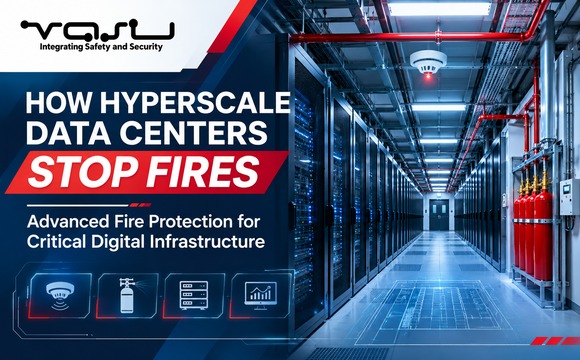
How Hyperscale Data Centers Stop Fires: Engineering Advanced Fire Protection for Critical Digital Infrastructure
Nov 2026
How Hyperscale Data Centers Stop Fires: Engineering Advanced Fire Protection for Critical Digital Infrastructure
Exploring advanced fire detection, suppression and integrated engineering strategies for hyperscale data centres.
Listen to the Podcast
Join Ayesha and Kabir for an engineering discussion on protecting hyperscale data centres and maintaining critical infrastructure resilience.
1. Episode Overview
Hyperscale data centres are essential to cloud computing, artificial intelligence, digital payments, telecommunications and mission-critical business operations.
As these facilities expand in scale, power density and infrastructure complexity, fire protection engineering must evolve beyond conventional detection and suppression approaches.
This episode explores integrated fire protection strategies designed to address human safety, critical digital assets and operational continuity.
2. Episode Summary
Ayesha and Kabir discuss the engineering challenges associated with fire protection in modern data centres, including server halls, UPS installations, battery systems, electrical infrastructure, cable galleries and cooling systems.
The discussion covers advanced detection, clean-agent suppression, water mist, lithium-ion battery risks, HVAC integration, Fire Alarm Systems, BMS, DCIM, EPMS and SCADA.
It also examines the importance of engineering coordination, Cause-and-Effect logic, commissioning, Integrated System Testing and lifecycle maintenance.
3. Key Discussion Areas
Data Centre Infrastructure
Hyperscale facilities, AI infrastructure, server racks and electrical distribution.
Fire Science
Fire tetrahedron, Heat Release Rate, smoke behaviour and risk assessment.
Early Detection
ASD, VESDA, point detection and multi-layer detection technologies.
Suppression Technologies
Clean agents, IG-100, IG-541, FK-5-1-12 and water mist systems.
Battery Protection
Lithium-ion thermal runaway, BESS and UPS fire risks.
System Integration
FAS, HVAC, BMS, DCIM, EPMS, SCADA and PLC interfaces.
Testing & Commissioning
FAT, SAT, Cause-and-Effect and Integrated System Testing.
Future Technologies
AI monitoring, predictive maintenance, digital twins and cybersecurity.
4. Integrated Fire Protection Strategy
An effective data centre fire protection architecture should address the complete incident lifecycle.
- Prevention: Electrical safety, thermal monitoring and preventive maintenance.
- Early Detection: Aspirating smoke detection and suitable fire detection technologies.
- Containment: Compartmentation, fire stopping and protected cable routes.
- Suppression: Application-specific clean-agent, water mist and sprinkler systems.
- Recovery: Emergency response, restoration and business continuity.
Different hazard zones require different protection strategies. Final selection should be based on project-specific engineering assessment.
5. Advanced Fire Detection Technologies
Early detection is particularly important in high-density server environments where an incident may affect critical digital operations.
- Aspirating Smoke Detection (ASD / VESDA)
- Point Smoke Detectors
- Multi-Criteria Detectors
- Linear Heat Detection
- Thermal Monitoring
- Flame Detection
- Selected Gas Detection Technologies
Detection selection should consider airflow, room configuration, equipment layout, environmental conditions and the approved fire strategy.
6. Fire Suppression Systems
Clean-Agent Systems
Clean-agent technologies are considered for sensitive electronic environments where residue-free suppression may be appropriate.
- FK-5-1-12
- IG-100
- IG-541
- Other approved clean-agent solutions
Water Mist Systems
High-pressure water mist systems use engineered nozzle arrangements to generate fine droplets for cooling and fire control in suitable applications.
Key Design Considerations
- Protected enclosure volume and design concentration
- Room integrity and pressure relief
- Hydraulic calculations and nozzle selection
- Occupant safety and evacuation
- Detection and release logic
- HVAC and electrical interfaces
7. Lithium-Ion Battery and BESS Protection
Lithium-ion batteries used in UPS and energy storage installations introduce specific hazards, including thermal runaway, off-gassing and potential propagation between cells.
- Battery Management System monitoring
- Cell temperature monitoring
- Gas and off-gassing detection
- Thermal runaway risk assessment
- Ventilation and emergency shutdown
- Propagation control and cooling strategy
- Emergency response and re-ignition monitoring
8. System Integration and Cause-and-Effect
Modern data centre fire protection requires coordination between multiple systems.
- FAS: Fire detection, alarm processing and emergency sequences.
- BMS: Building services and HVAC monitoring.
- DCIM: Data centre infrastructure and environmental monitoring.
- EPMS: Electrical power monitoring.
- SCADA / PLC: Industrial monitoring and control interfaces.
The Cause-and-Effect Matrix defines initiating events, system responses, alarms, delays, interfaces and approved emergency sequences.
FAT, SAT, functional testing and Integrated System Testing help validate the complete protection architecture.
9. Applicable Standards and References
- NFPA 75 – Fire Protection of Information Technology Equipment
- NFPA 76 – Fire Protection of Telecommunications Facilities
- NFPA 72 – Fire Alarm and Signaling Code
- NFPA 2001 – Clean Agent Fire Extinguishing Systems
- NFPA 855 – Stationary Energy Storage Systems
- NFPA 750 – Water Mist Fire Protection Systems
- ISO 14520 – Gaseous Fire-Extinguishing Systems
- ISO 7240 – Fire Detection and Alarm Systems
- EN 54 – Fire Detection and Fire Alarm Systems
- TIA-942 – Telecommunications Infrastructure Standard for Data Centers
- National Building Code of India
- Relevant FM Global Data Sheets and Uptime Institute guidance
Applicable editions, regulatory requirements and project specifications must be verified during engineering and design.
10. Indian Data Centre Infrastructure
India’s digital infrastructure growth is supported by cloud adoption, artificial intelligence, financial technology, telecommunications and high-performance computing.
Major data centre markets include Mumbai, Chennai, Hyderabad, Bengaluru, Pune and Delhi NCR.
Increasing rack density, electrical capacity and battery installations create new requirements for integrated fire protection engineering.
11. Technical Takeaways
- Fire protection must address human safety, critical equipment and operational continuity.
- Different data centre hazard zones require different engineering solutions.
- Early smoke detection supports timely investigation and response.
- Clean-agent and water mist systems must be evaluated for their specific applications.
- Lithium-ion battery risks require dedicated assessment.
- Fire alarm, HVAC, electrical and monitoring interfaces must be coordinated.
- Cause-and-Effect validation and Integrated System Testing are essential.
- Lifecycle maintenance and cybersecurity support long-term infrastructure resilience.
- AI can support monitoring and predictive maintenance, subject to suitable validation.
12. Speaker Details
Ayesha
Podcast Host
Kabir
Guest Speaker
13. Full Podcast Transcript
The complete VEP-003 speaker-wise transcript should be maintained in accordance with the final podcast recording, preserving the original technical discussion, speaker contributions and engineering explanations.
14. Related VASU Insights
Explore related technical resources from VASU Infosec: